


Plan to Reduce Energy Consumption
SDG 7.2.4
Sunway University has adopted a long-term, structured approach to upgrading its existing buildings in order to achieve higher energy efficiency and align with international sustainability standards. Since 2018, a series of targeted initiatives have been implemented across campus facilities, demonstrating a consistent institutional commitment to reducing energy consumption, optimising building operations, and integrating sustainable technologies.
The Energy Efficiency Upgrade Plan (2018–2026) outlines these initiatives, including:
- Optimization with technology through adoption of district cooling system technology and centralized chiller management (2018).
- Reducing wastage by installing timers to reduce the operating time of hot water boilers (2019).
- Upgrading to energy-efficient fittings such as retrofitting LED lights to reduce energy consumption (2019–2020, 2021–2022, with further review in 2024).
- Motion-triggered lighting for all common areas (2020–2023).
- Energy audits and building energy intensity monitoring (from 2021 onwards).
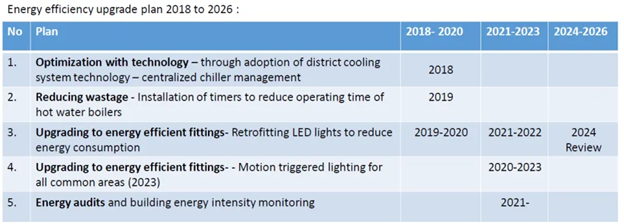
This plan provides a comprehensive framework to systematically reduce overall energy consumption across the University’s existing buildings, while also ensuring continuous improvement in energy efficiency.
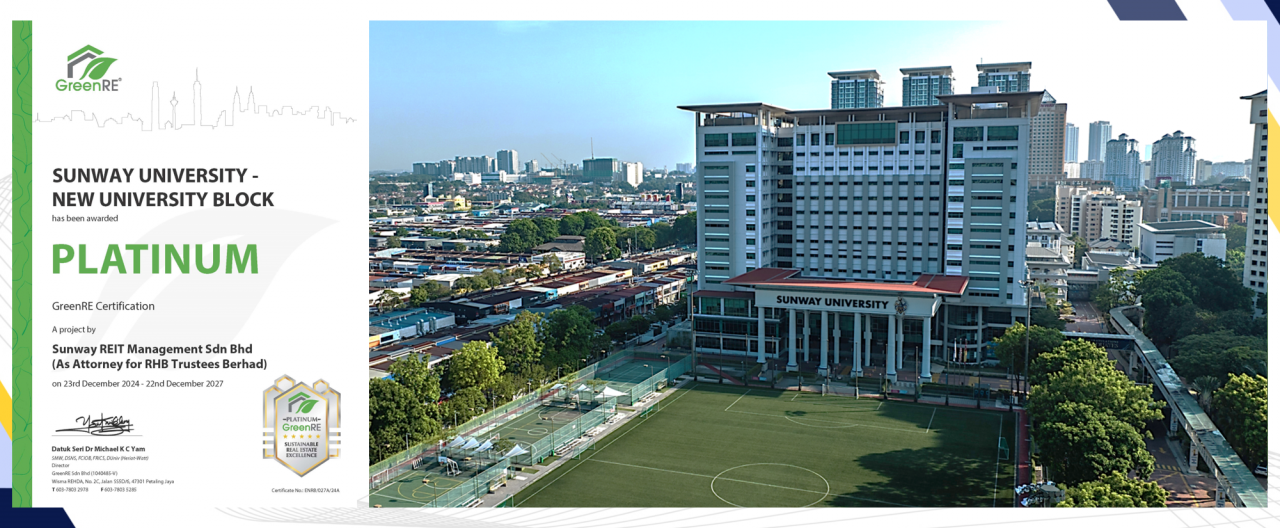
The outcomes became evident in 2024, when the University’s building achieved the Platinum rating under the GreenRE Existing Non-Residential Building (ENRB v3.3) certification tool, the highest level of recognition awarded by GreenRE. The ENRB v3.3 framework evaluates existing non-residential buildings across six environmental impact categories: energy efficiency, water efficiency, sustainable operations and management, indoor environmental quality, other green features, and carbon emissions. To qualify, projects must meet minimum thresholds, including at least 30 credits in energy-related requirements and 20 credits in other green requirements, while a score of 90 or above is required to attain the Platinum rating. This certification demonstrates that the University’s planned initiatives to enhance the performance of existing building infrastructure have been successfully implemented to the highest sustainability standards in 2024.
In addition, the University is currently developing the Faculty of Engineering & Technology (FET) Annex Building, which will expand its state-of-the-art laboratories, including facilities for Electronic Engineering, Civil Engineering, and Virtual Reality. The Annex is being redeveloped with a Net Zero package, incorporating rooftop solar panels with battery storage microgrid, a Building Energy Management System with smart sensors, AI dashboard monitoring, and digital twin integration. The building design further integrates:
- Sustainable furniture and fit-outs, with waste upcycled into furniture
- Comprehensive waste management covering construction and daily operations
- Green concrete and pre-cast concrete construction methods
- Heat-insulating exterior paint and air-purifying interior paint
- Rainwater harvesting system and district cooling system for high-efficiency cooling.
The Annex Building is also designed in full adherence to the University’s Green Building Guideline, ensuring consistency with institutional sustainability standards and practices.
Furthermore, the development forms part of an ongoing research project led by FET researchers in the Net Zero field, positioning the facility as a living testbed for sustainable building technologies. The project is scheduled for completion by 2026, further illustrating the University’s long-term strategy to upgrade its existing infrastructure in line with advanced sustainability and energy efficiency standards.


